
ღონისძიებები
2026 ახალგაზრდა მეცნიერთა ვორქშოპი
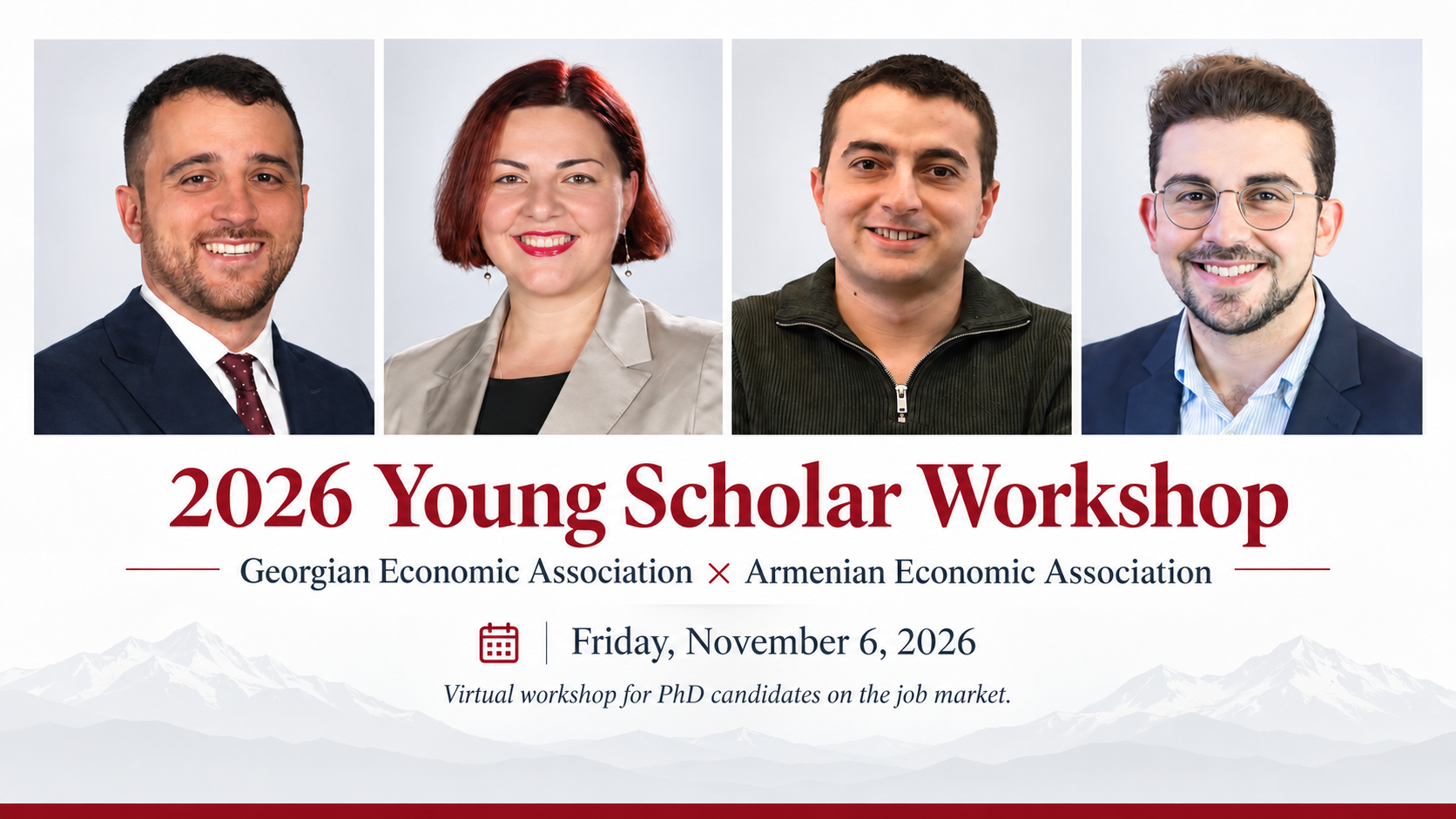
GEA × AEA · Young Scholar Workshop
The Georgian Economic Association and the Armenian Economic Association are pleased to jointly organize the 2026 Young Scholar Workshop, a virtual workshop for PhD students entering the academic job market.
The workshop provides a collegial forum for young scholars to present their research, receive feedback, and connect with the wider academic community across Georgia, Armenia, and beyond. This year’s program features four job market candidates.
| Date | Friday, November 6, 2026 |
| Format | Virtual · Free and open to all |
| Time | 6:00–8:30 PM Tbilisi/Yerevan · 9:00–11:30 AM EST |
Program
| 18:00–18:30 9:00–9:30 AM EST |
Ararat Gocmen · University College London Immigration and Firm Investment |
| 18:30–19:00 9:30–10:00 AM EST |
Juan Ignacio Jacoubian · Boston University Trade Shocks, Currency Unions and the Role of Fiscal Transfers |
| 19:00–19:15 10:00–10:15 AM EST |
Networking break |
| 19:15–19:45 10:15–10:45 AM EST |
Ana Mazmishvili · Georgia Institute of Technology The Effects of Environmental Markets on Vulnerable Communities: Evidence from the Regional Greenhouse Gas Initiative |
| 19:45–20:15 10:45–11:15 AM EST |
Mushegh Tovmasyan · Université Paris-Saclay Trade and Firm-Level Adjustments to Geopolitical Shifts: Evidence from Armenia |
| 20:15–20:30 11:15–11:30 AM EST |
Networking |
Presenters and papers
 |
Ararat GocmenUniversity College London Immigration and Firm Investment Abstract. The paper studies how firms' access to finance shapes their investment response to immigration-driven labor-supply shocks and, in turn, the effects of immigration on native workers. A model with credit-market frictions predicts weaker investment responses among highly leveraged firms. Evidence from Germany during the 2010s shows that firms with higher initial leverage increased capital investment and borrowing by less and experienced larger declines in capital-labor ratios and native earnings in response to immigration shocks. About the presenter. Ararat is a PhD candidate in Economics at University College London and a Research Officer at the Centre for Research and Analysis of Migration. His research lies at the intersection of labor and financial economics, with a focus on migration, firms, and private-enterprise financing. |
 |
Juan Ignacio JacoubianBoston University Trade Shocks, Currency Unions and the Role of Fiscal Transfers Abstract. The paper asks whether cross-country fiscal transfers can help currency-union members adjust to asymmetric effects of a common trade shock when monetary policy cannot respond to country-specific conditions. Using a quantitative trade model and applying it to the 2025 U.S. tariff shock in the euro area, the analysis shows that targeted transfer rules can reduce labor-market distortions, with effectiveness depending on where induced demand is directed. About the presenter. Juan Ignacio is a PhD candidate in Economics at Boston University. His research is in international trade and macroeconomics, with particular emphasis on the propagation of trade shocks and their interaction with monetary and fiscal policy. |
 |
Ana MazmishviliGeorgia Institute of Technology The Effects of Environmental Markets on Vulnerable Communities: Evidence from the Regional Greenhouse Gas Initiative Abstract. The paper evaluates how the Regional Greenhouse Gas Initiative affected emissions and the distribution of local pollution exposure across communities. Using plant-level emissions data, a difference-in-differences design, and air-quality dispersion modeling, the study finds substantial declines in emissions in participating states and evidence that disadvantaged communities experienced comparatively larger reductions in local pollution exposure. About the presenter. Ana is a PhD candidate in Economics at the Georgia Institute of Technology. Her research interests include environmental, energy, and housing economics, with a focus on the distributional consequences of environmental and energy policy. |
 |
Mushegh TovmasyanUniversité Paris-Saclay Trade and Firm-Level Adjustments to Geopolitical Shifts: Evidence from Armenia Abstract. The paper examines how sanctions on a major trading partner affect firms, workers, and trade in a non-sanctioning economy, using Armenia's response to Western sanctions on Russia. Combining transaction-level customs data with employer–employee records, it documents Armenia's growing intermediary role and studies how trading firms adjust products, sourcing, turnover, employment, and wages. A quantitative model is used to assess the welfare implications. About the presenter. Mushegh is a PhD candidate at Université Paris-Saclay (RITM). His research is in international trade and development, focusing on trade policy, geopolitical fragmentation, and their effects on firms and labor markets. |
Jointly organized by the Georgian Economic Association and the Armenian Economic Association.
Register · AEA workshop page · Georgian Economic Association